
When jingles hit the spot, happy sponsors sell a lot
Part 1 of 2
Date: August 19, 1977
By: Bill Milkowski
Of the: Journal Staff
|
When jingles hit the spot, happy sponsors sell a lot Date: August 19, 1977 By: Bill Milkowski Of the: Journal Staff |
|
You hear their voices and compositions every time you turn on your radio or television but you'll probably never know their names. If your washing your clothes with Dynamo detergent, brushing your teeth with Macleans or drinking Dr. Pepper, chances are a jingle writer put you up to it. Are you chewing Doublemint? Drinking Lipton tea? Eating Cheerios or Frosted Mini Wheats? Maybe it was the catchy music that did the selling job. Or perhaps it was that rich tenor voice, that bouncy beat and those cheery lyrics that made you rush out and buy a Buick or a bottle of Heinz ketchup. These are the great songs of Madison Avenue. They're quick, bright fanfares that grab the listener, and in many cases they are the best music being played on the air today. |
The jingle industry began as a private joke back in 1939 when radio announcer Alan Kent and his British born program director Ginger Johmson wrote a wild commercial announcement with a drafty musical background. Since then every merchant with a product to push has invested in these smart phrases and rhymes linked to a catchy tune. And it usually pays off for them.
There are four jingle studios in Milwaukee churning out those local ditties you hear on the radio or TV. Many of the professional musicians you see in nightclubs around town, including members of the Milwaukee Symphony Orchestra, moonlight in these studios during their spare time. They can make from $40 to $100 per session. Some local freelancers are making a career of it.
|
Keep it simple
The four or five clever jingle writers in town agree on the basic formula behind a sucessful jingle: keep it simple and sell the product.
Bill Eisner, one of the creative bunch at Bananas Studio, draws on a background in psychology and marketing demographics when composing his jingles. Among the 300 or so tunes he has written are spots for Northridge and Southridge, Krause Oldsmobile and station identifications for WITI-TV. His national accounts include Sears Die Hard batteries and Pabst Blur Ribbon beer.
Eisner, 22, does the selling, writing, producing and engineering at his studio on 94th and Forest Home Ave. After sending out demonstration tapes to various advertising agencies he will
|
|
When jingles hit the spot, happy sponsors sell a lot Date: August 19, 1977 By: Bill Milkowski Of the: Journal Staff |
|
|
get a call from some interested client to dicuss business and map[ out a campaign. Before creating a speculative jingle, or a rough draft in sound, there are several critical questions to consider. Who does this product appeal to -- men, women, children, upper class, middle class? Once that is established he must consider the vehicle -- rock, jazz, country western, classical or easy listening?
For Security Savings & Loan he worked up five seperate versions of the same tune, each appealing to a different audience. "Since they have such a broad audience, we did an easy listening version for WEZW, a country version for WBCS and a rock version for WOKY," Eisner explained. The male vocalist belt out the same catchy lyrics ("You want security, Security wants you") but the pace swithches with the format. Expensive Tunes Sometimes the client will offer lyrics or even a theme. But more often Eisner will end up composing music and writing lyrics to a fact sheet. "on our Boy Blue jingle we were looking to reach children and mothers. They told us they wanted a spot that represented the personality of the store - a fun place to eat." So he drummed up a bouncy cartoon like synthesizer beat and he overdubbed a background track of laughing kids to help get the message across. "ofd course, we all want our music to sound good, but we must accomplish the selling goals of the client," said Eisner. Sometimes the ideas come instantly, but with fussy clients it can take up to a week to work up a speculative jingle. Businesses invest from $1,000 to $5,000 for these tunes and are usually cautious about the images they project, When the jingle works it can mean a great boost in revenue. One of the more successful Milwaukee jingle writers is Terry Sweet, who works out of his home at 2347 N. 117th St. with wife Pam and partner Mike Balistierri. Unlike Eisner, who composes and records in the same Milwaukee studio, Sweet does most of his recording in Dallas, Chicago or New York City. " The biggest weakness in Milwaukee is the fact that studios just are,nt good enough for our clients. Quality is the name of the game and we're setting out to be the Cadillac in the field," he said. The musicians here are as good as anywhere else, particularly the symphony players, but we're weak on top notch singers here." Tough to stay at home Eisner is working to keep the Milwaukee market alive in the jingle field. "We're trying to beat the rap that you have to go out of town to work," he said. "We're trying to keep business in town to help the local musicians and help ourselves."
|
Another Jingle Producer who believes in the local market is Dave Neitzke of Star Studio on 37th and National Ave. "Many businesses were going out of state to get there work done, but they want to avoid all the transportation costs, he said. "I'm trying to stay in Milwaukee but it hasn't been easy. So this is my last fling, and if it doesn't go "i'll have to move."
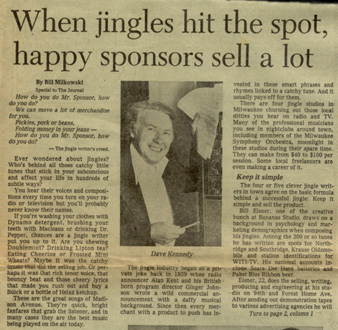
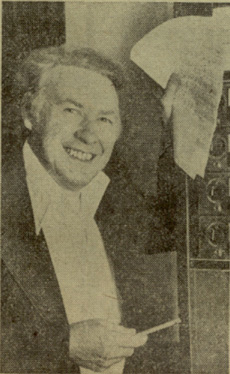
Sweet 26, worked for Bananas for two years before starting out on his own in the business today and today most of the business is coming to him. He has done Jingles for Gimbles, Boston Store, Cilento Photography Studio, Schlesinger Chevrolet and hundreds more. And it all began for him six years ago with a little ditty for the Mayfair Shopping Center. 'Old' fatal to jingle Composing a jingle campaign for a client is an instinctive thing for Sweet, somewhere between art and business. "I'ts a combnination of creating a piece of music, but at the same time it's got to be a marketing tool. Jingle trends tend to follow the Top 40 record trends, so you have to keep your mind contemporary. If you start sounding old you're in big trouble." Dave Keeendy is the acknowledged father of recording in Milwaukee. He's been in the jingle business for 30 years and his studio on Wisconsin Ave. is the biggest in the state. His interest in electronics led him to develope one of the first multichannel recording systems in the country. Until four years ago Kennedy produced about 90% of the jingles in town, and he has a seperate library to store all the thousands of jingles he's dreamed up over the years. Today the jingle game trepresents a small part of his business, but many of his original jingles are still being played. Kennedy's first jingle for Kuehn & Sons Rambler, recorded in 1950, is still in cirrculation. "They got a lot of milage out of that thing," he siad. His jingles for Ernie Von Schledorn, Kohls' Food Stores, Patrick Cudahy, Manpower Business Training Institute and Phil Tolkan Pontiac are other examples of his oldies but goodies." "Some clients want a whole novel stuffed into a 60 second commercial. It may sound good as poetry or just read out aloud, but you have to make modifications so it stays in the proper meter. Too many syllables could sound awkward," he said, which might explain why Kennedy had such a tough time writing a jingle for Kosciuszko Furniture Stores. So the next time you hear one of those 60 second ditties on your radio or TV think about how it got there. The hours of brainstorming, the gathering of musicians, the recording and overdubbing and mixing sessions in the studio, the clients whims -- these are all part of the endless game of jingle making. And it begings with the jingle writer, an artist who's hip to psychology and marketing. |