
This One Man Orchestra is a Record Company, Too
Part 1 of 2
Date: September 23, 1967
By: MARGARET BREMNER
Of the: Journal Staff
|
This One Man Orchestra is a Record Company, Too Date: September 23, 1967 By: MARGARET BREMNER Of the: Journal Staff |
|
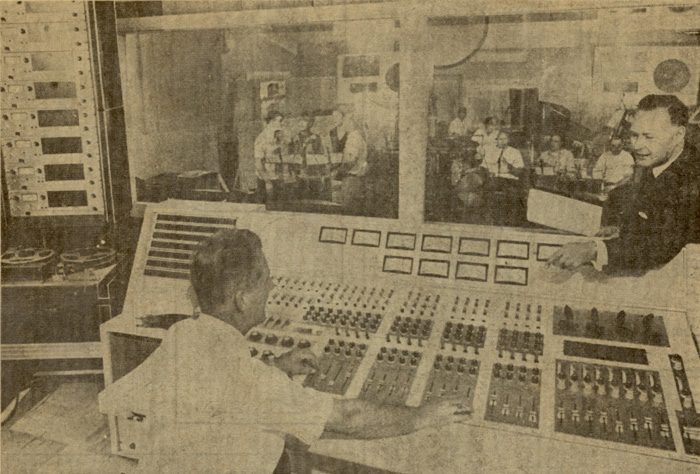 Custom made rcording equipment enables engineer Ed Giese (left) and producer Dave Kennedy to
alter a recording after it is made at the Dave Kennedy Recording studios, 2755 N. 3rd st. |
|
You can't believe your ears. That is if Dave Kennedy has anything to do with it. he's a musical arranger, composer and businessman who knows electronics.
Versatile Kennedy plays all the instruments for a 45 piece orchestra and strings, recording the sounds in the Dave Kennedy Recording Studios, 2755 N. 3rd st. In three hours, Kennedy can record 23 instruments for a two minute recording of the pop tune "I remember You." He timed it. If Kennedy isn't the only 45 piece orchestra, he is the fastest. He records his one man orchesrta on his custom built eight channel Ampex tape recorder which, as he puts it, "gives me any sound I want -- later."
Kennedy's last 13 ---------??MISSING 1 PARAGRAH RIGHT HERE
|
make authentic Horatio Alger material. "Istatred out a pretty poor boy," Kennedy admits. He now owns Milwaukee's major recording studio with equipment he claims isn't duplicated in the middle west.
His object is to "put Milwaukee on the map as a leading recording center such as Nashville or Chicago," and to put local musician talent to work. Appropriately, his favorite production was composing, arranging and producing the musical soundtrack for the film, " We Like It Here," for the state of Wisconsin. Played Violin At 3, Kennedy was was picking out tunes on the piano in his Wales (Wis.) home. He played violin in the Waukesha high school orchestra and was graduated from the Wisconsin Conservatory of Music in 1952 with a bachelor's degree in composition, a teaherls certificate in piano and a diploma in violin. Kennedy's Horatio Alger story began in the mid-1950s when he was working seven nights a week at the Holiday House for $65. Impressed by multitrack recordings, kennedy spent two weeks' pay on a tape recorder endorsed by Les Paul and Mary Ford.
|
" I tried it out that night after work," he said, "but it was junk. I sold it the next morning."
Kennedy's theory was that if Les Paul and Mary Ford could sound like several voices and instruments then "I could record all the instruments in an orchestra and become my own one man orchestra." After 10 years of practice, Kennedy's theory developed into a big band sound. "I'm a proffesional musician and my lifes ambition was to become a band leader. I was determined to make a hit record and needed the money to do it," he said. So he borrowed $4,000. Kennedy's friend Ed Giese, helped him with the electronics of multitracking. "At first we practiced at Ed's house. We ere too noisy and his wife couldent stand it. Then we set up at our house and my wife kicked us out. We had nowhere to go, so we rented a studio," Kennedy explained. His first studio was located at 4504 W. North av.
|
"I was forced into this business. From there, this just happened," Kennedy said, looking over his posh office.
Versitility is the key to much of Kennedy's sucess. His knowledge in musical arranging and composing combined with his knowledge as a recording engineer is a marketable product. His one man orchestra is, too. A person can walk into Kennedy's studio with an idea of a song in his head and in a day or two have a disk recording of it in his hands, the 42 year old entrepreneur said. Orders Pressings Kennedy individually cuts acetates or record dubs on a lathe in his studio. He orders pressings from Chicago and claims "24 to 48 hour service." "You sing a song and I'll write the composition on a piece of paper," said Kennedy. "Then I'll make the arrangement for orchestra and chorus. I'll either hire musicians
Turn to page 3, column 5 |
|
This One Man Orchestra is a Record Company, Too Part 2 of 2 He's Sing Too, But.... Date: September 23, 1967 By: MARGARET BREMNER Of the: Journal Staff |
|
|
Page 3, column 5 continued from page 1
or be the orchestra myself."
"I'd sing, too, if my voice didn't sound like a cross between Selma Diamond and Andy Devine," he added.
Kennedy enthusiasticly explained how his eight channel tape recorder fits into the picture.
"The machine is completely flexible, giving the director complete control and comand of the rcording after it is recorded," he said. The $20,000 machine is equivelent to eight synchronized tape recorders. Eight persons or groups can each record on a seperate track. After the recording is made, the director
|
can individually control volume, echo, equilizer, and compressor of each track.
For example, a rock group using the eight channels could record the snare drum,bass drum, rhythm guitar, lead guitar, lead voice, groups humming, clapping and saxaphone each on a seperate track. If the lead voice was too soft, it's volume couldn't be raised without without altering any other part of the recoring. If desired, more echo could be added to the rhythm guitar and less to the lead guitar -- without affecting any other instruments. And without affecting Kennedy's wife and five children who live at 4430 W. Meinecke av. |